

How to use a SUP from a Sailing Yacht
Sailing tips · Watersports
A stand-up paddleboard turns every anchorage into a playground. Paddle into caves, explore the shoreline, or simply float in the sunshine while the yacht swings gently at anchor.
This SUP yacht guide covers how to set up your board, launch it from the yacht and get back on board, paddle safely when the wind picks up, and store it while you sail.
In short
To use a SUP from a sailing yacht, inflate the board to the pressure printed by the valve, fit the fin and leash, and launch it over the side while holding the leash. Walk it round to the stern, where it’s easiest to climb on and off. Always wear the leash, paddle upwind of the yacht when there’s a breeze, and tie the board securely to the guardrails, clear of the sheets, while you sail. You can add a paddleboard to any Seafarer flotilla as an optional extra.
5–10
minutes to inflate a board
12–15 psi
typical inflation pressure
Force 3
wind to stay upwind of the yacht
From £100
a week to add a paddleboard
On this page
Getting ready
Setting up your SUP on the yacht
Most yacht paddleboards are inflatable, so they pack small and set up quickly. Allow five to ten minutes.
Inflate the board
Open the valve before you fit the pump, then inflate to the pressure printed by the valve, usually 12 to 15 psi. An under-inflated board feels wobbly and slow.
Fit the fin and leash
Slide the fin into its box and attach the leash to the D-ring at the back of the board.
Set the paddle length
Stand the paddle up and reach above your head: the handle should sit in your raised hand, roughly at wrist height.

On and off the boat
Launching and recovering a SUP from a yacht
The stern is the best place to get on and off the board, as the bathing platform and ladder sit close to the water.
- Launch: lower the board over the side while holding the leash, then walk it round to the stern.
- Get on: step down from the bathing platform into the middle of the board, starting on your knees.
- Get back on board: paddle to the stern, kneel, and hand the paddle up first.
- Lift it out: it’s much easier with two people, one in the water or on the platform and one on deck.
Daryl shows how to launch, paddle, and recover a SUP from a sailing yacht
Technique
Paddling techniques for beginners
Start on your knees until you feel balanced, then stand up one foot at a time, with your feet either side of the carry handle on the centre of the board.
- Look ahead, not at your feet: it helps your balance.
- Keep your knees soft and your back straight.
- Use your core, not just your arms, to pull the paddle through the water.
- Switch sides every few strokes to keep a straight line.
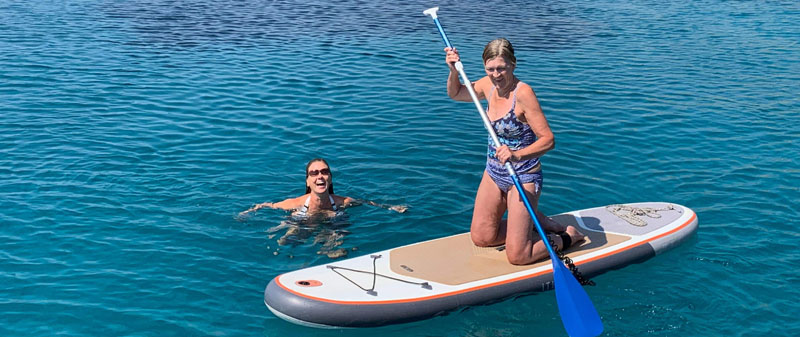
Stay safe
SUP safety from a yacht
- Always wear the leash: an inflatable board can blow away faster than you can swim after it.
- Buoyancy aids: recommended for children and weaker swimmers. Ask us and we’ll arrange them for your yacht.
- Watch the wind: from about force 3, stay upwind of the yacht so the breeze brings you home.
- If you can’t get back: kneel to paddle, or lie on the board and paddle with your hands to reduce windage.
- Tell someone: let the crew know where you’re going and when you’ll be back.
Ask your lead crew
On a flotilla, the lead crew will tell you at the morning briefing which bays are best for paddleboarding and when the afternoon breeze is due.
Under way
Storing your SUP while you sail
Tie the board securely to the guardrails along the side deck, with the fin removed or facing outwards, and keep it clear of the jib sheets. If you won’t use it for a few days, deflate it and pack it in its bag, out of the sun, as UV damages the material over time.
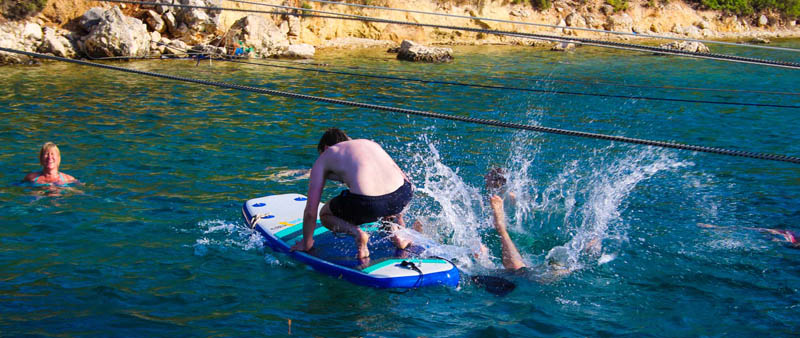
Book a board
Adding a SUP to your yacht holiday
You can add a stand-up paddleboard to any of our flotillas as an optional extra, from £100 for the week. On our Thailand and British Virgin Islands flotillas, paddleboard hire is £200. Just ask our team when you book.
Travelling with children? Our family flotilla holidays guide has more ideas for fun on the water, and our packing list for a Greek sailing holiday covers what to bring.

Common questions
SUP from a yacht: your questions answered
Can you take a SUP on a sailing holiday?
Yes. You can add a stand-up paddleboard on any Seafarer flotilla as an optional extra, from £100 a week. It’s inflatable, so it stores easily on board.
How do you get on a SUP from a yacht?
Launch the board over the side while holding the leash, walk it round to the stern, and step down from the bathing platform into the middle of the board, starting on your knees.
How do you get back on a SUP from the water?
Approach the board from the side, hold the carry handle in the middle, and kick your legs up as you pull yourself across it, then move to your knees.
What pressure should a SUP be inflated to?
Use the pressure printed next to the valve, usually between 12 and 15 psi for an inflatable board.
Is it safe to paddleboard when it’s windy?
Take care from about force 3. Stay upwind of the yacht, and if you struggle to get back, kneel or lie down on the board to paddle.
Ready to paddle?
Plan your sailing holiday
Tell us when you’d like to sail and who’s coming, and we’ll add a paddleboard to your yacht.
Call or email us
Monday to Friday 09:00 to 19:00 · Saturday 09:30 to 17:00


Book with confidence. Seafarer has run sailing holidays since 1995, and every payment you make to us is financially protected: ATOL licence 9511 for holidays with flights, ABTOT member 5660 for holidays without.