How to Moor Stern-To: A Step-by-Step Guide to Med Mooring
Sailing tips · Boat handling
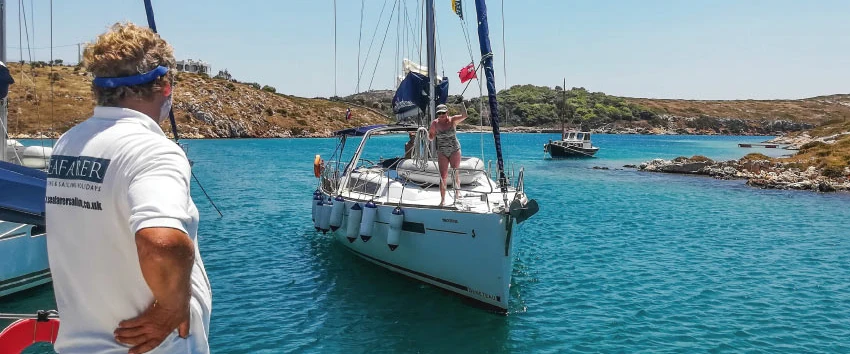
Many sailors who learned in the tidal waters around the UK arrive in the Mediterranean worried about one thing: stern-to mooring. With no tide to allow for, town quays and marinas fit more boats in by mooring them with the stern facing the quay. It makes stepping ashore easy and creates a sociable quayside atmosphere, and with a little planning it’s a simple manoeuvre.
In short
To moor stern-to, prepare fenders and stern lines, then reverse slowly towards the quay while dropping your anchor about four boat lengths out. Stop paying out chain at about one boat length off so the anchor digs in, take the windward stern line ashore first, then the leeward one, and finally tighten the anchor chain. In many marinas you pick up a lazy line instead of using your anchor.
4
boat lengths out to drop the anchor
1
boat length off to stop paying out chain
2
stern lines, windward first
3
crew roles: helm, windlass and stern lines
On this page
Before you start
Prepare the boat and crew
As with any sailing manoeuvre, a plan and a well-prepared boat make all the difference. Do these before you start your approach. For more on getting ready for a charter, see our practical yacht charter tips.
The boat
- Fenders out on both sides
- Anchor lowered slightly out of the bow roller, ready to drop
- Both stern lines secured to the stern cleats, ready to take ashore
- A passerelle or plank ready for stepping ashore
The crew and the plan
- Check the wind direction and any hazards, such as moored boats or swimmers
- One crew member on the windlass at the bow
- If possible, someone on the stern lines in the cockpit
- Agree clear signals between the helm and the bow
Step by step
Mooring stern-to with your anchor
In many town quays, especially in Greece, you moor using your own anchor. Our guide is for the lighter winds you’ll usually find in a sheltered harbour.
Choose your space
Look for a gap that suits your yacht. Don’t squeeze into one that’s far too small, and you won’t be popular if you take a space that could fit two boats.
Drop the anchor about four boat lengths out
Approach the space in reverse and drop the anchor about four boat lengths from the quay, in line with your neighbours’ chains so you don’t cross them.

Reverse slowly towards the quay
Keep the stern turned towards the wind and balance the boat’s speed with the chain going out on the windlass.
Stop paying out at about one boat length off
Stop the windlass so the anchor digs in, with the engine in neutral and a touch of ahead to bring the yacht to a stop. If no one is on the quay to take your lines, stop where a crew member can step ashore safely.
Take the windward stern line ashore first
Pass it through a ring or round a bollard at roughly 45 degrees to the boat, and back to the crew in the cockpit to make fast. Then do the same with the leeward line, adjusting both until the yacht is the right distance from the quay. The skipper may need to motor gently ahead or astern.
Tighten the anchor chain
Take up the slack on the windlass until the chain is at about 45 degrees, which sets the boat in its final position. If you’re leaving the boat, put a snubber line from the chain to a foredeck cleat to take the load off the windlass.


In marinas
Mooring stern-to with a lazy line
In busy harbours and most marinas, particularly in Croatia, you won’t use your own anchor. Instead, each berth has a lazy line: a light line running from the quay to a heavier mooring line fixed to a block on the seabed. It stops anchors fouling each other.
Reverse in and take the windward stern line ashore
Prepare as before, back gently into the berth and make the windward stern line fast first.
Pick up the lazy line
Take the lazy line from the quay, walk it forward outside everything and lead the heavy mooring line to a bow cleat. Pull it tight and make it fast.
Make fast the second stern line
Then attach the leeward stern line and adjust both lines and the bow line until the yacht sits square and clear of the quay.
Watch your propeller
Keep the lazy line well away from the propeller while you pick it up, and avoid going astern while it’s in the water.
When it’s windy
Mooring stern-to in a crosswind
Crosswind
Drop the anchor slightly upwind of your gap, so the wind pushes you into it rather than onto your neighbour, and keep plenty of fenders on the leeward side. You may need a little more speed to keep steerage.
Wind blowing off the quay
Treat it like normal anchoring: drop the anchor about four boat lengths out, reverse gently, and snub the chain at about one boat length so it digs in before you take the stern lines ashore.
See it in action
Watch our stern-to mooring video
Our video shows a light-wind stern-to mooring using the anchor.
Still not sure? Our 2-day and 5-day Pre-Flotilla Courses give you time on the water with an instructor, practising the boat handling you want to work on, including mooring. And on every flotilla, our lead crew are on the quay to help you in. New to flotillas? Our first-timer’s guide explains how a flotilla week works.
Common questions
Stern-to mooring: your questions answered
What is stern-to mooring?
It’s mooring with the back of the boat facing the quay, held off by your anchor or a lazy line at the bow and two stern lines ashore. It’s the usual way to moor in the Mediterranean, where there’s little tide.
How far out should I drop the anchor?
About four boat lengths from the quay, in line with the neighbouring boats’ chains.
What is a lazy line?
A light line running from the quay to a heavier mooring line fixed to the seabed. You lead it to the bow instead of using your own anchor, which stops anchors fouling each other in busy marinas.
Will someone help me moor on a flotilla?
Yes. On our flotillas, the lead crew help you into the harbour each evening and can take your lines.
Ready to try it?
Practise with us
Build your confidence on a Pre-Flotilla Course, or join a flotilla where our lead crew are there to help you moor each evening.
Call or email us
Monday to Friday 09:00 to 19:00 · Saturday 09:30 to 17:00


Book with confidence. Seafarer has run sailing holidays since 1995, and every payment you make to us is financially protected: ATOL licence 9511 for holidays with flights, ABTOT member 5660 for holidays without.