Dodecanese: The Ultimate Sailing Adventure in Greece
Sailing guide · Dodecanese
The Dodecanese is for sailors who want more than an easy cruise. Fresh winds, longer open-water passages, and islands full of history make it one of Greece’s most rewarding sailing areas.
Picture sailing past the medieval walls of Kos and Rhodes, beneath the volcanic cliffs of Nisyros, and into Symi’s neoclassical harbour. This guide covers our Dodecanese flotilla routes, yacht charter options, the islands not to miss, and what to expect from the wind.
In short
Dodecanese sailing suits intermediate to experienced sailors, with fresh winds of typically Force 3 to 6+ and some longer open-water passages. With Seafarer, you can join our flotilla from Kos Marina, which alternates weekly between a Symi route and a Kalymnos route, or charter a yacht from Kos or Rhodes. The season runs from May to October, with the strongest winds during the meltemi, from late July to late August.
F3–6+
typical winds on open water
2
flotilla routes from Kos
~110 nm
sailed in a flotilla week
May–Oct
sailing season
On this page
Why go
Why sail the Dodecanese?
The Dodecanese rewards confident sailors with reliable breezes and a real sense of journey. Ashore, you’ll find Kalymnos’s sponge-diving heritage, the quiet islands of Lipsi and Nisyros, Byzantine monasteries, and Venetian ports.
Fresh, reliable winds
Typically Force 3 to 6+ on open water, for satisfying sailing days.
A real sense of journey
Some longer passages between islands make every arrival feel earned.
History everywhere
Medieval fortresses, monasteries, and neoclassical harbours at almost every stop.
Quieter than the Cyclades
Fewer crowds, more space in harbour, and plenty of peaceful bays.
There are two ways to sail here with Seafarer: join our Dodecanese flotilla with lead crew support, or charter a yacht and take full control.
Flotilla
Flotilla sailing: guided freedom from Kos
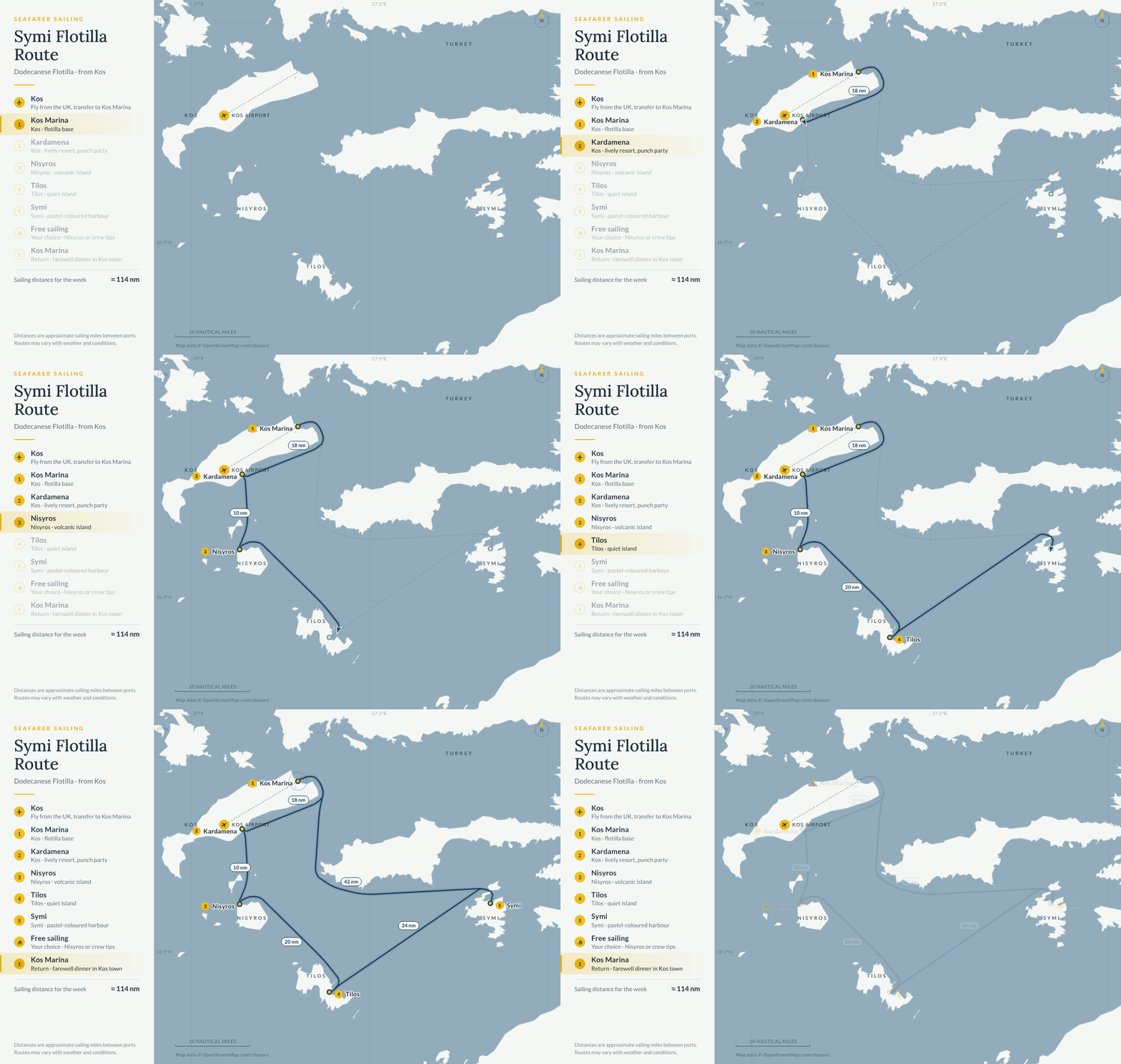
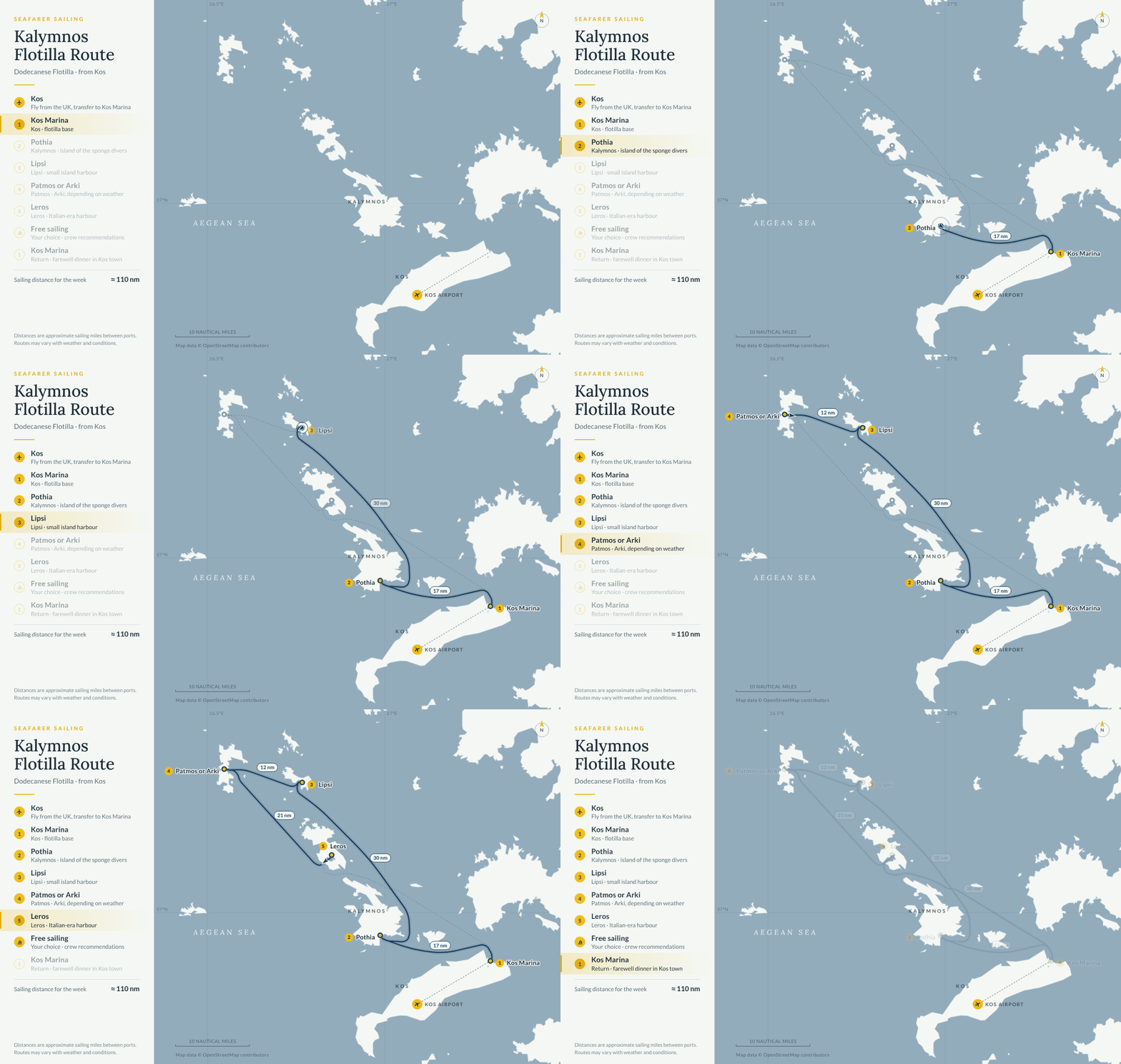
Our flotilla is based at Kos Marina, on the east side of Kos town. You skipper your own yacht, with a lead crew sailing nearby to help with local knowledge, berthing, and the weather. Flotillas run Saturday to Saturday, and the route alternates each week: odd weeks sail the Symi route, even weeks the Kalymnos route.
Symi route
About 114 nm · south
- Kos to Kardamena (18 nm)
- Kardamena to Nisyros (10 nm), with its volcanic crater
- Nisyros to Tilos (20 nm)
- Tilos to Symi (24 nm) and its colourful harbour
- A free-sailing day, then back to Kos
Kalymnos route
About 110 nm · north
- Kos to Pothia, Kalymnos (17 nm)
- Kalymnos to Lipsi (30 nm)
- Lipsi to Patmos or Arki (12 nm)
- On to Leros (21 nm)
- A free-sailing day, then back to Kos
- Prices from £1,956 per yacht for a week
- Yachts from 34 to 51ft with three to five cabins, plus the Lagoon 42 catamaran
- Best for more experienced sailors
- No experience? Add a skipper from €200 a day plus expenses
- Fly to Kos, with direct Saturday flights from several UK airports and a transfer of about 30 minutes
Routes can change with the weather. See all dates and prices on the Dodecanese flotilla page.
Yacht charter
Yacht charter: plot your own course
Prefer full independence? Charter a yacht or catamaran from Kos or Rhodes, either bareboat or with a skipper. Two of our favourite itineraries:
Rhodes to Kos
One way · Rhodes base
Symi, Nisyros, Tilos, Halki, and Kos, finishing among the walls of Rhodes Old Town.
Kos North and West
Two weeks · Kos base
Patmos, Leros, Kalymnos, Arki, Levitha, and Astypalaia, for a longer adventure.
Skippering yourself?
You’ll need an ICC to bareboat in Greece. Our guide to the ICC licence in Greece explains how to get one, and how to choose a yacht helps you pick the right boat.
Where to stop
Unmissable Dodecanese islands
- Rhodes: a medieval Old Town, with history by day and lively evenings.
- Kos: sunny beaches and ancient ruins, and home to our flotilla base.
- Symi: neoclassical mansions stacked around one of Greece’s prettiest harbours.
- Patmos: the Monastery of St John above a whitewashed hilltop village.
- Nisyros: an active volcanic crater and quiet whitewashed villages.
- Halki: peaceful, with Venetian character and crystal-clear water.
- Arki: a tiny island with a blue lagoon and the nearby islet of Marathos.
On the flotilla route
- Kalymnos: the island of the sponge divers, with a lively harbour at Pothia, a hilltop castle, and museums telling the divers’ story.
- Lipsi: a tiny, unspoilt island fringed with craggy islets and quiet beaches, and home to a marine conservation institute.
- Leros: a dramatic castle above the windmills of Platanos, and the Italian-era waterfront of Lakki, where the flotilla moors.
- Tilos: off the beaten track, with castles built against pirates. It was one of the first islands in the Mediterranean to run on wind and solar power.


Nisyros, Halki, and Leros.
Local flavours
Island food here follows the sea. Look out for the tiny fried Symi shrimp, octopus drying in the sun before it hits the grill, and chickpea fritters. On Kos, try krasotyri, a local cheese aged in red wine.
Add a week ashore
To combine your flotilla with a week on land, Kefalos Beach Club in the south-west of Kos offers world-class windsurfing, dinghy sailing, kayaking, and SUP. Ferries from Kos port also run to Rhodes, Samos, and even Bodrum in Turkey, if you want to explore further.
For more on the islands, see Visit Greece’s official Dodecanese guide.
A little history
A short history of the Dodecanese
Sitting on the old trade routes between Greece, Turkey, and Egypt, the Dodecanese has changed hands more often than almost anywhere in Greece. Every ruler left something behind, so a week’s sailing takes you past ancient temples, crusader castles, and Italian harbour fronts.
5th century BC
Hippocrates of Kos
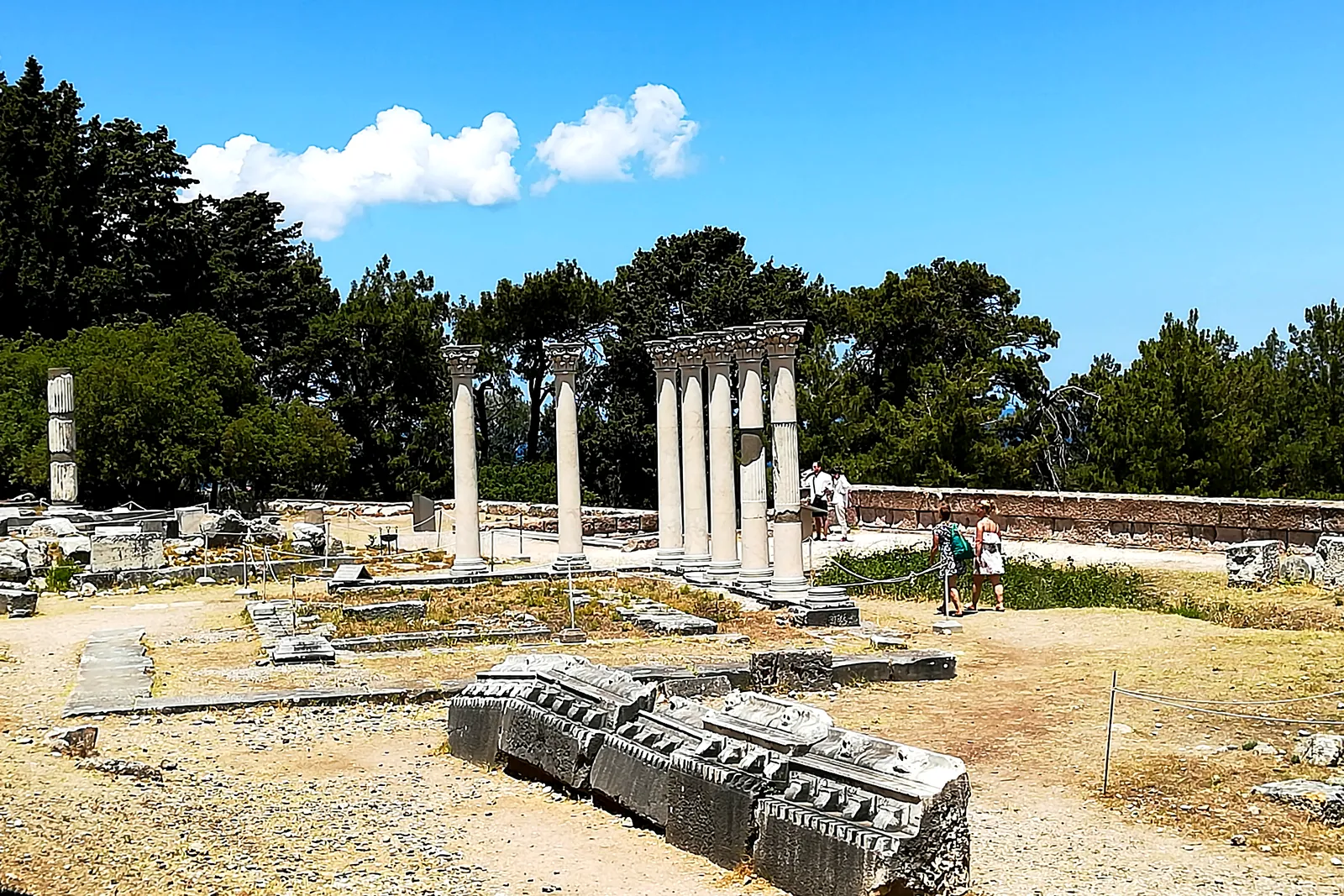
Kos was the home of Hippocrates, the father of medicine. After his death, the island built the Asklepieion, a great healing sanctuary whose terraces still stand just outside Kos town.

3rd century BC
The Colossus of Rhodes
Rich from trade, Rhodes raised a giant bronze statue of the sun god Helios near its harbour, one of the Seven Wonders of the Ancient World. An earthquake toppled it after only about 50 years.

1st to 11th century
St John on Patmos
Under Roman rule, St John lived in exile on Patmos, where he wrote the Book of Revelation. In 1088, monks founded the fortified Monastery of St John that still crowns the island.
1309 to 1522
The Knights of St John
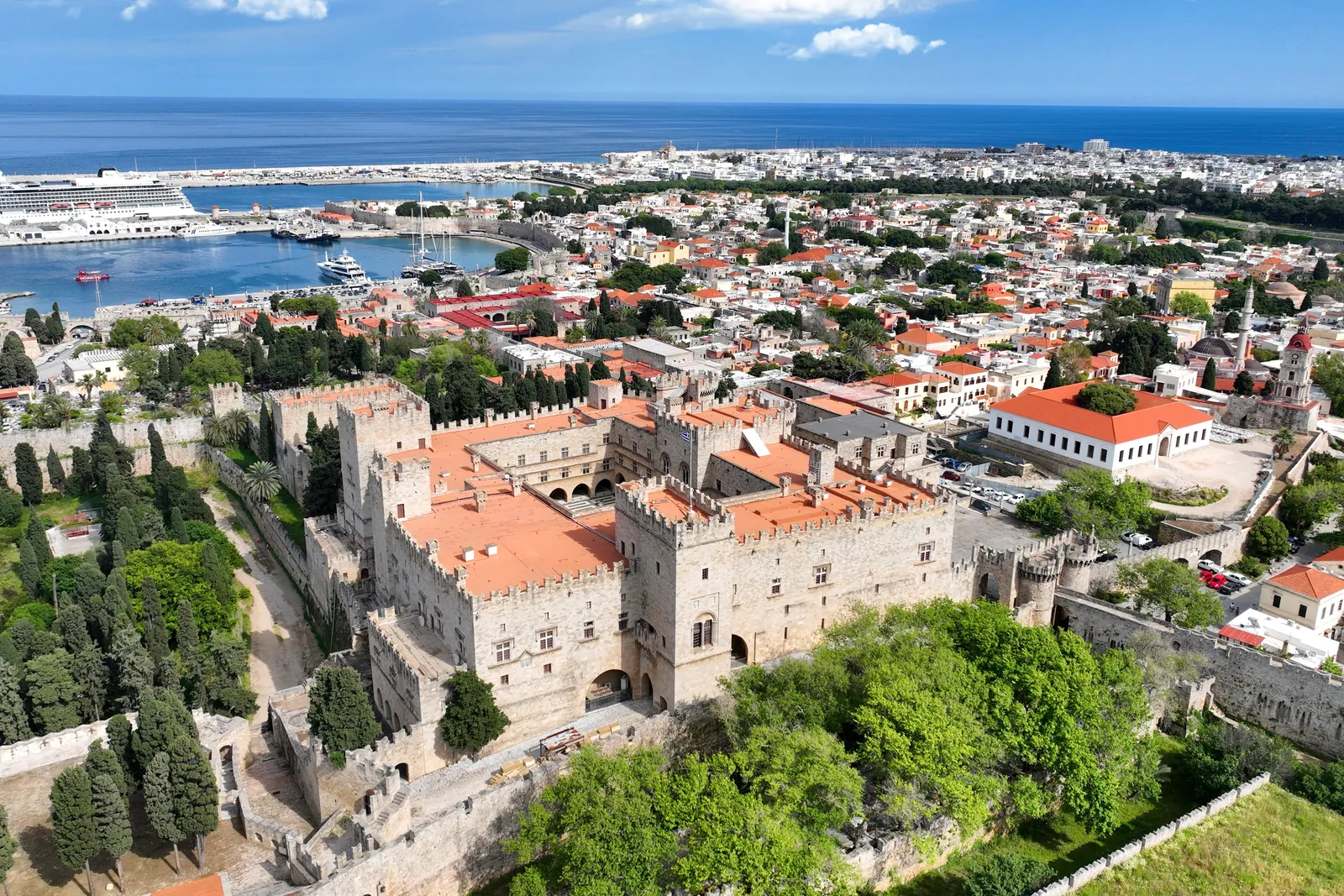
The crusading Knights Hospitaller made Rhodes their home and built castles across the islands, from Rhodes Old Town to Kos and Leros. They held out until the Ottomans took Rhodes in 1522.

1522 to 1943
Ottomans and Italians
The islands spent almost four centuries under Ottoman rule, then Italy took them in 1912. The Italians left grand civic buildings in Rhodes and Kos, and the whole town of Lakki on Leros.

1945 to 1948
Greek at last
After fierce fighting in the Second World War, including the Battle of Leros in 1943, the German surrender of the Dodecanese was signed on Symi in 1945. The islands finally joined Greece in 1948.
Wind and weather
What to expect from the wind and weather
| When | Conditions | Best for |
|---|---|---|
| May to June | Mild temperatures, lighter winds, and calm harbours | A gentler start to the season |
| July to August | The meltemi blows strongest from late July to late August, often Force 5 to 6+ | Experienced, confident sailors |
| September to October | Warm seas and reliable breezes | Great sailing with fewer crowds |
About the meltemi
The meltemi is a strong, dry summer wind from the north. It brings clear skies and exhilarating sailing, but it can make some passages demanding, so plan around the forecast.
Compare
Dodecanese, Ionian, or Cyclades?
| Area | Typical winds | Best for |
|---|---|---|
| Dodecanese | Force 3 to 6+ | Confident, adventurous sailors |
| Ionian Islands | Gentler, around Force 2 to 4, with short hops | Beginners and families |
| Cyclades | Strong meltemi, Force 5 to 7, and rugged coasts | Advanced sailors |
If you want challenge with culture and a little more space, the Dodecanese is hard to beat.
Common questions
Dodecanese sailing: your questions answered
Is the Dodecanese good for beginner sailors?
It’s best for more experienced sailors, as the winds are fresher and some passages are longer. If you’re new to sailing, you can add a skipper, or start in the Ionian, where conditions are gentler.
Where does the Dodecanese flotilla start?
At Kos Marina, on the east side of Kos town. Flotillas run Saturday to Saturday, and the Kos airport transfer takes about 30 minutes.
When is the best time to sail the Dodecanese?
May, June, September, and October bring calmer conditions. July and August are the windiest months, with the meltemi strongest from late July to late August.
Do I need a qualification to charter a yacht?
Yes, to skipper a bareboat yourself in Greece you need an ICC. Without one, you can charter with a skipper.
Ready for an adventure?
Talk to us about sailing the Dodecanese
Whether you join our flotilla or charter your own yacht, we’ll help you plan the right Dodecanese sailing holiday.
Call or email us
Monday to Friday 09:00 to 19:00 · Saturday 09:30 to 17:00

Book with confidence. Seafarer has run sailing holidays since 1995, and every payment you make to us is financially protected: ATOL licence 9511 for holidays with flights, ABTOT member 5660 for holidays without.